

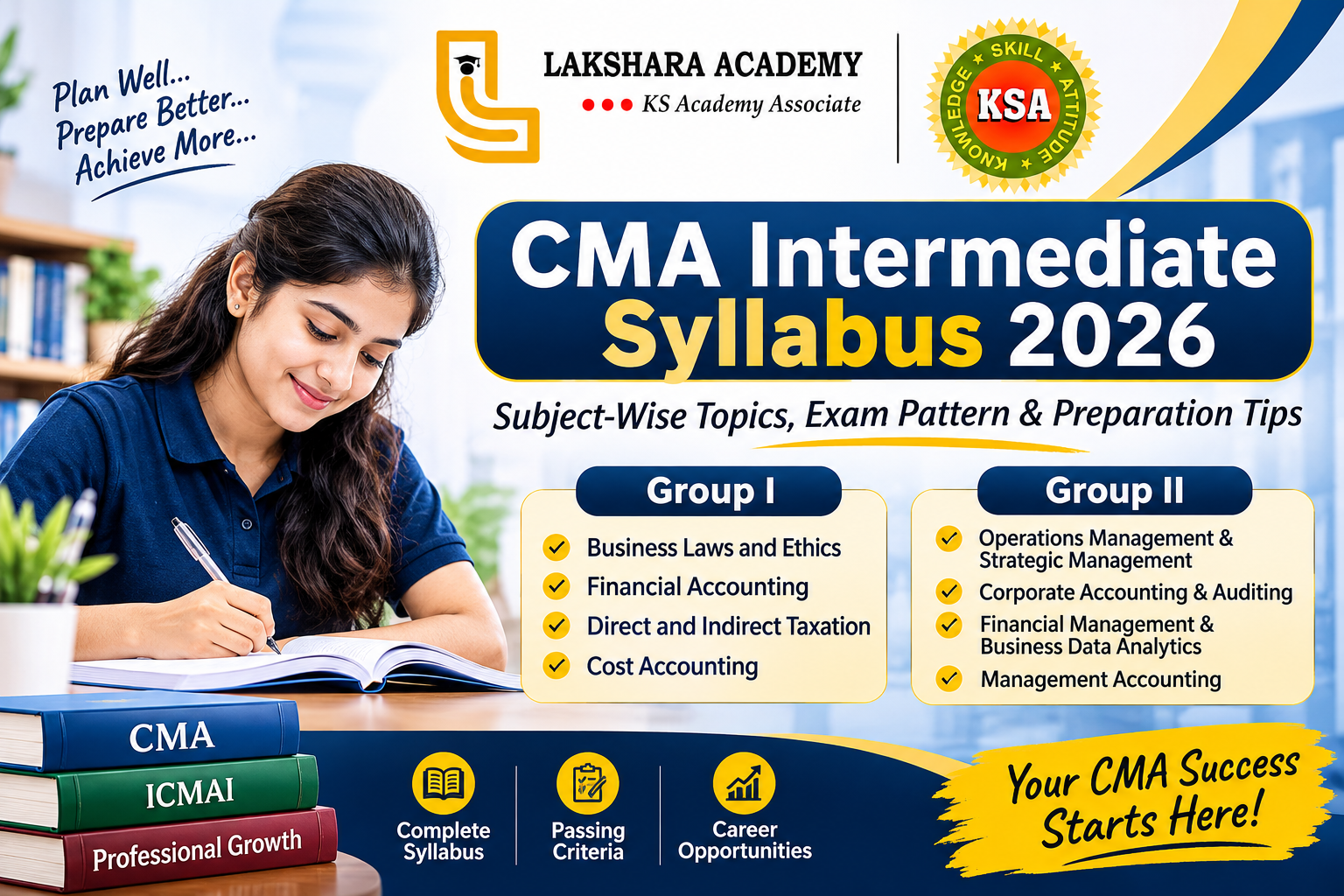
The CMA Intermediate level is an important stage in the Cost and Management Accountancy course. It introduces students to advanced accounting, taxation, costing, financial management, corporate laws, and business decision-making.
Students preparing for the 2026 examinations should understand the syllabus, identify the subjects in each group, and plan their preparation accordingly. The CMA Intermediate course builds the knowledge required to work in finance, costing, taxation, management accounting, and corporate operations.
This guide explains the CMA Intermediate Syllabus 2026, including all eight papers, group-wise subjects, key topics, and preparation tips.
CMA Intermediate Course Overview
The CMA Intermediate course follows the ICMAI Syllabus 2022. It contains eight papers divided into two groups. Each paper carries 100 marks, making the total 800 marks.
Students can prepare for Group I, Group II, or both groups together, depending on their examination plan.
| Group | Paper | Subject |
| Group I | Paper 5 | Business Laws and Ethics |
| Group I | Paper 6 | Financial Accounting |
| Group I | Paper 7 | Direct and Indirect Taxation |
| Group I | Paper 8 | Cost Accounting |
| Group II | Paper 9 | Operations Management and Strategic Management |
| Group II | Paper 10 | Corporate Accounting and Auditing |
| Group II | Paper 11 | Financial Management and Business Data Analytics |
| Group II | Paper 12 | Management Accounting |
The CMA Course overview helps students understand how Intermediate connects the Foundation level with the Final level. The subjects also develop practical knowledge used in business and industry.
For the official syllabus, visit the ICMAI Intermediate Course Curriculum.
Group I – CMA Intermediate Subjects and Syllabus
Paper 5 – Business Laws and Ethics
Business Laws and Ethics introduces students to commercial, industrial, and corporate laws. It also develops an understanding of professional ethics.
Important topics include:
- Indian Contract Act
- Sale of Goods Act
- Negotiable Instruments Act
- Partnership Act
- Limited Liability Partnership Act
- Industrial laws
- Companies Act, 2013
- Business ethics and emotional intelligence
Students should understand legal provisions, important definitions, and their practical application. Regular revision can help retain important sections and concepts.
Paper 6 – Financial Accounting
Financial Accounting focuses on recording business transactions and preparing financial statements. It develops the accounting knowledge needed for professional work.
Important topics include:
- Accounting fundamentals
- Accounting for special transactions
- Preparation of financial statements
- Partnership accounts
- Lease accounting
- Branch and departmental accounts
- Accounting standards
Students should practise journal entries, adjustments, ledger accounts, and financial statement problems. Understanding the concepts is more useful than memorising formats.
Paper 7 – Direct and Indirect Taxation
Taxation is an important part of the CMA Intermediate syllabus. This paper covers both direct and indirect taxes.
Direct Taxation topics include:
- Basic concepts of income tax
- Residential status
- Income from different heads
- Computation of total income
- Tax deductions and exemptions
- Tax liability calculation
- Relevant tax provisions
Indirect Taxation topics include:
- GST concepts
- Supply of goods and services
- Levy and collection of GST
- Input Tax Credit
- Registration
- Tax invoices
- Returns and compliance
- Customs basics
Students should use the applicable tax amendments and supplementary materials for their examination term.
Paper 8 – Cost Accounting
Cost Accounting teaches students how to calculate, analyse, and control the cost of products and services.
Important areas include:
- Introduction to cost accounting
- Cost classification and cost concepts
- Material, labour, and overhead costs
- Methods of costing
- Job and batch costing
- Process costing
- Contract costing
- Cost accounting techniques
- Cost control and cost analysis
Regular problem-solving is essential. Students should practise working out costs step by step and understand how each cost component affects the final calculation.
Group II – CMA Intermediate Subjects and Syllabus
Paper 9 – Operations Management and Strategic Management
This paper combines operations management with strategic management. It explains how businesses improve productivity, manage resources, and plan for long-term growth.
Operations Management includes:
- Production planning and control
- Plant location and layout
- Inventory management
- Quality management
- Operations research basics
- Productivity and process improvement
Strategic Management includes:
- Business strategy
- Strategic planning
- Environmental analysis
- Competitive strategy
- SWOT analysis
- Strategic implementation
- Business performance and control
Students should connect the theories with practical business examples to understand how companies make operational and strategic decisions.
Paper 10 – Corporate Accounting and Auditing
Corporate Accounting and Auditing introduces company-related accounting transactions and audit procedures.
Important topics include:
- Company accounts
- Share capital and debentures
- Corporate financial statements
- Accounting for corporate transactions
- Auditing fundamentals
- Audit planning and procedures
- Internal control
- Audit evidence and reporting
Students should practise accounting adjustments and understand the purpose of audit procedures. This paper combines numerical practice with theoretical concepts.
Paper 11 – Financial Management and Business Data Analytics
Financial Management focuses on the financial decisions of a business. Business Data Analytics introduces students to the use of data for business analysis. (Financial Management and Business Data Analytics)
Financial Management topics include:
- Financial management concepts
- Financial planning
- Capital structure
- Cost of capital
- Working capital management
- Investment decisions
- Financial analysis
Business Data Analytics topics include:
- Data concepts
- Data collection and processing
- Data analysis
- Business applications of analytics
- Interpretation of information
- Data-based decision-making
The subject helps students understand how financial planning and data analysis support business decisions.
Paper 12 – Management Accounting
Management Accounting focuses on using financial and cost information for planning, control, and decision-making.
Important topics include:
- Introduction to management accounting
- Activity-Based Costing
- Decision-making tools
- Standard costing
- Variance analysis
- Forecasting
- Budgeting and budgetary control
- Divisional performance measurement
- Responsibility accounting
- Decision theory
Students should practise numerical questions regularly. Focus on understanding the formulas and learning when to apply each technique.
CMA Intermediate Passing Criteria
Students should understand the CMA Passing criteria before choosing whether to attempt one group or both groups.
Under the usual ICMAI examination scheme, students must secure at least 40% marks in each paper and at least 50% aggregate in the group. Candidates appearing for both groups together must satisfy the applicable aggregate and group-wise conditions prescribed by ICMAI.
Students should check the current examination notification for the latest rules on exemptions, group passing, and carry-forward of marks.
Preparation Tips for CMA Intermediate 2026
A well-planned timetable helps students manage eight subjects without losing focus.
- Divide the syllabus into weekly targets.
- Study practical subjects consistently.
- Revise theory subjects using short notes.
- Practise taxation questions using the applicable amendments.
- Solve previous examination papers.
- Take mock tests under exam conditions.
- Review mistakes and revise difficult topics.
- Keep time for revision before the examination.
Students can download the latest ICMAI CMA Intermediate study materials and refer to the ICMAI syllabus resources for official learning materials and practice resources.
Academic Guidance for CMA Intermediate Students
CMA Intermediate requires a balanced approach to theory, practical subjects, and revision. Regular classes, doubt clarification, and structured practice can help students stay on track.
Students searching for the Best CMA Coaching Centre in Chennai can compare faculty experience, syllabus coverage, test schedules, revision support, and study resources before choosing an academy.
Lakshara Academy, an extension of KS Academy, supports students pursuing professional courses through academic guidance and structured learning. Students can explore available CMA programmes and select a learning approach that suits their preparation needs.
CMA Intermediate and Future Career Opportunities
The Intermediate level develops skills in accounting, costing, taxation, finance, auditing, and business analysis. These subjects provide a foundation for further professional study and practical training.
Students progressing through the Stages in CMA can explore areas such as cost accounting, financial analysis, budgeting, taxation, internal audit, and management accounting as they continue towards qualification.
The course also helps students understand the skills needed for future CMA career opportunities. Salary levels vary by qualification stage, experience, location, industry, and job responsibilities. Students interested in CMA salary in India should consider how practical experience and specialised skills influence long-term career growth.
Conclusion
The CMA Intermediate Syllabus 2026 covers eight papers across Group I and Group II. It develops knowledge in business laws, accounting, taxation, costing, operations, auditing, finance, analytics, and management accounting.
Students should begin with the official syllabus and create a practical timetable. Consistent study, problem-solving, revision, and mock examinations can make preparation more effective.
Understanding the syllabus early helps students organise their efforts and prepare confidently for the CMA Intermediate examinations. A disciplined approach can also build a strong foundation for the Final course and future professional opportunities.
Frequently Asked Questions
CMA Intermediate contains eight papers divided into two groups. Each group has four papers, and each paper carries 100 marks.
Group I includes Business Laws and Ethics, Financial Accounting, Direct and Indirect Taxation, and Cost Accounting.
Group II includes Operations Management and Strategic Management, Corporate Accounting and Auditing, Financial Management and Business Data Analytics, and Management Accounting.
Students generally need at least 40% marks in each paper and 50% aggregate in the group. Candidates attempting both groups should check the current ICMAI examination rules for the applicable group-wise and aggregate requirements.
Students can download the official syllabus and study materials from the ICMAI website. The Intermediate Curriculum and Study Materials sections provide the subject details and resources for the applicable syllabus.